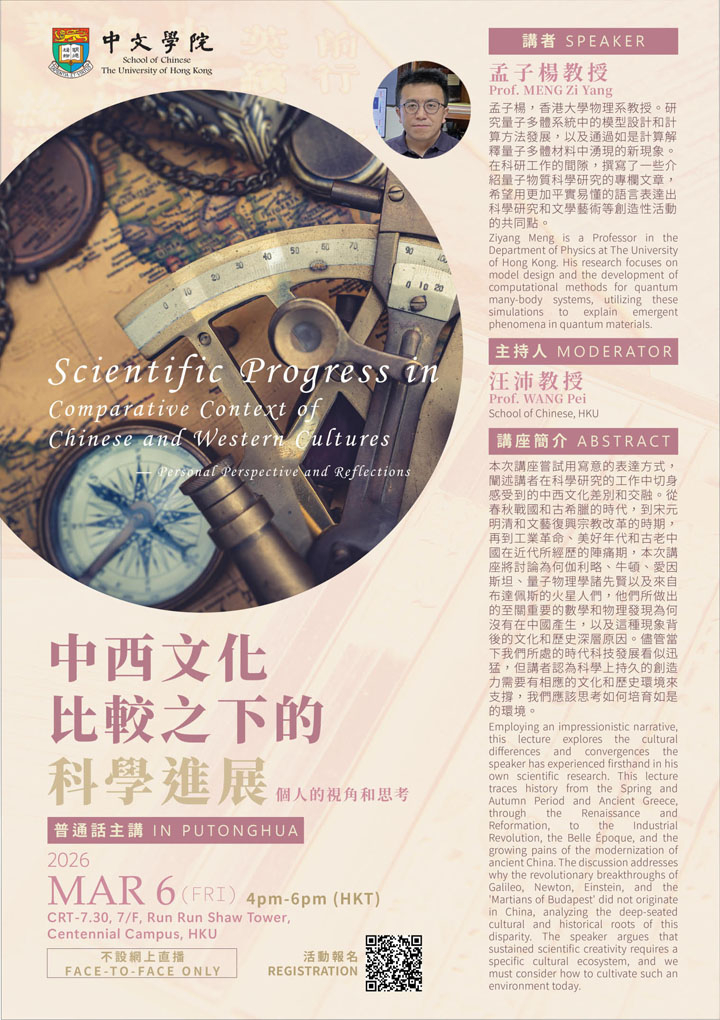
中西文化比較之下的科學進展 —— 個人的視角和思考


这是與中文學院一次有趣的聯動,講者嘗試用寫意的方式,闡述在科學研究的工作中切身感受到的中西文化差別和交融。從春秋戰國和古希臘的時代,到宋元明清和文藝復興宗教改革的時期,再到工業革命、美好年代和古老中國在近代所經歷的陣痛期,本次講座將討論為何伽利略、牛頓、愛因斯坦、量子物理學諸先賢以及來自布達佩斯的火星人們,他們所做出的至關重要的數學和物理發現為何沒有在中國出現,以及這種現象背後的文化和歷史深層原因。儘管當下我們所處的時代科技發展迅猛,但講者認為科學上持久的創造力與相應的文化和歷史環境有密不可分的關聯,我們或許應該將一部分註意力用來思考如何構建培育如是科學成果的環境。Register here


PHYS8202: Quantum Many-Body Computation

HKU PHYS8202: Quantum Many-Body Computation
Purpose of the Course:
Computational approaches are playing increasingly important roles in the advances of condensed matter physics and quantum material research, particularly in quantum many-body systems. In recent years, a new trend of research, combining computational methods, such as exact diagonalization, quantum Monte Carlo, tensor network and neural network, and theoretical approaches such as quantum field theory and symmetry analysis, has emerged and enabled scientists to thoroughly, and in an interdisciplinary manner, investigate the highly entangled quantum phases of matter, 2D moiré materials, quantum simulators, etc. Considering these rapid developments and their lack of systematic education to senior undergraduate students, graduate students and researchers in Hong Kong and the GBA area, I have designed this course to cover from basic to advanced topics in quantum many-body computation and theoretical understanding in strongly correlation aspects of quantum materials. I plan to teach the participants basic and live knowledge of modern quantum many-body computation, such that they can apply them into their research works in the corresponding areas.
Lecturer: Zi Yang Meng
Tutor: Min Long, Shibo Shan
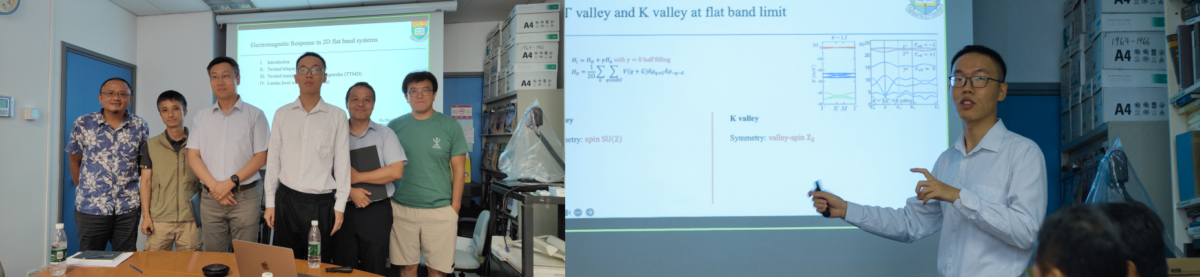
PHYS4150/8150: Computational Physics

HKU PHYS4150/8150: Computational Physics
Purpose of the Course:
This course shows the power of the computational approach to solving physics and related problems, which is complementary to the traditional experimental and theoretical approaches. Students are expected to spend a significant fraction of time in actual programming. This is an elective course for the computational physics theme.  This is also an essential course for those who plan to pursue postgraduate studies in fields like computational physics, condensed matter physics, chemistry, and engineering or work in related areas.
Lecturer: Zi Yang Meng
Tutor: Tim Lok Chau, Menghan Song

PHYS3151: Machine learning in Physics

HKU PHYS3151: Machine Learning in Physics
Purpose of the Course:
Machine learning is a technique that enables computers to learn without being explicitly "programmed''. It is an essential part of big data science and has been widely used in different fields of physics. This course introduces the basics of machine learning, from key concepts to practical algorithms, with a focus on real-world applications in physics. It is an elective course for the computational physics theme. This is also an essential course for those who plan to apply machine learning techniques in their postgraduate studies such as condensed matter physics and astrophysics or in their future work.
Lecturer: Zi Yang Meng
Tutor: Tim Lok Chau